Long Put Payoff Diagram — Series 7 Cheat Sheet & Full Walkthrough
Updated April 2026 · 6 min read · Part of the Series 7 Options Crash Course
If you're cramming, the cheat sheet at the top has everything you need. If you want to actually understand long puts so you don't have to re-memorize this every time, scroll past it.
The 60-Second Cheat Sheet
For any long put position on the Series 7:
| Metric | Formula | Memory hook |
|---|---|---|
| Maximum loss | Premium paid | "You can only lose what you put in" |
| Maximum gain | (Strike − Premium) × 100 | Stock can only fall to zero |
| Breakeven | Strike − Premium | "Pay to play, then drop below strike" |
| Profitable when | Stock price < Strike − Premium | Below breakeven |
| At expiration | Exercise if stock < strike, else let expire | OTM puts expire worthless |
The trap question pattern: The exam will give you a long put and ask for max gain. Candidates who memorized "long call = unlimited" will pick "unlimited" by analogy. Wrong. A stock can only fall to $0, so max gain on a long put is capped at strike minus premium, times 100. This is the single most-missed long put question type.
Worked Example (the one from the video)
Buy 1 XYZ January 50 put at 4. Stock drops to 38. What's the max gain?
- Strike: 50
- Premium paid: 4 (× 100 shares = $400 total cost)
- Breakeven: 50 − 4 = $46
- Profit at $38: ($46 − $38) × 100 = $800
- Max loss: $400 (the premium, if stock stays at or above $50)
- Max gain: ($50 − $4) × 100 = $4,600 (when stock hits $0)
The $800 is the current unrealized gain. The maximum possible gain is $4,600 — what you'd make if XYZ went bankrupt and shares went to zero.
The Payoff Diagram
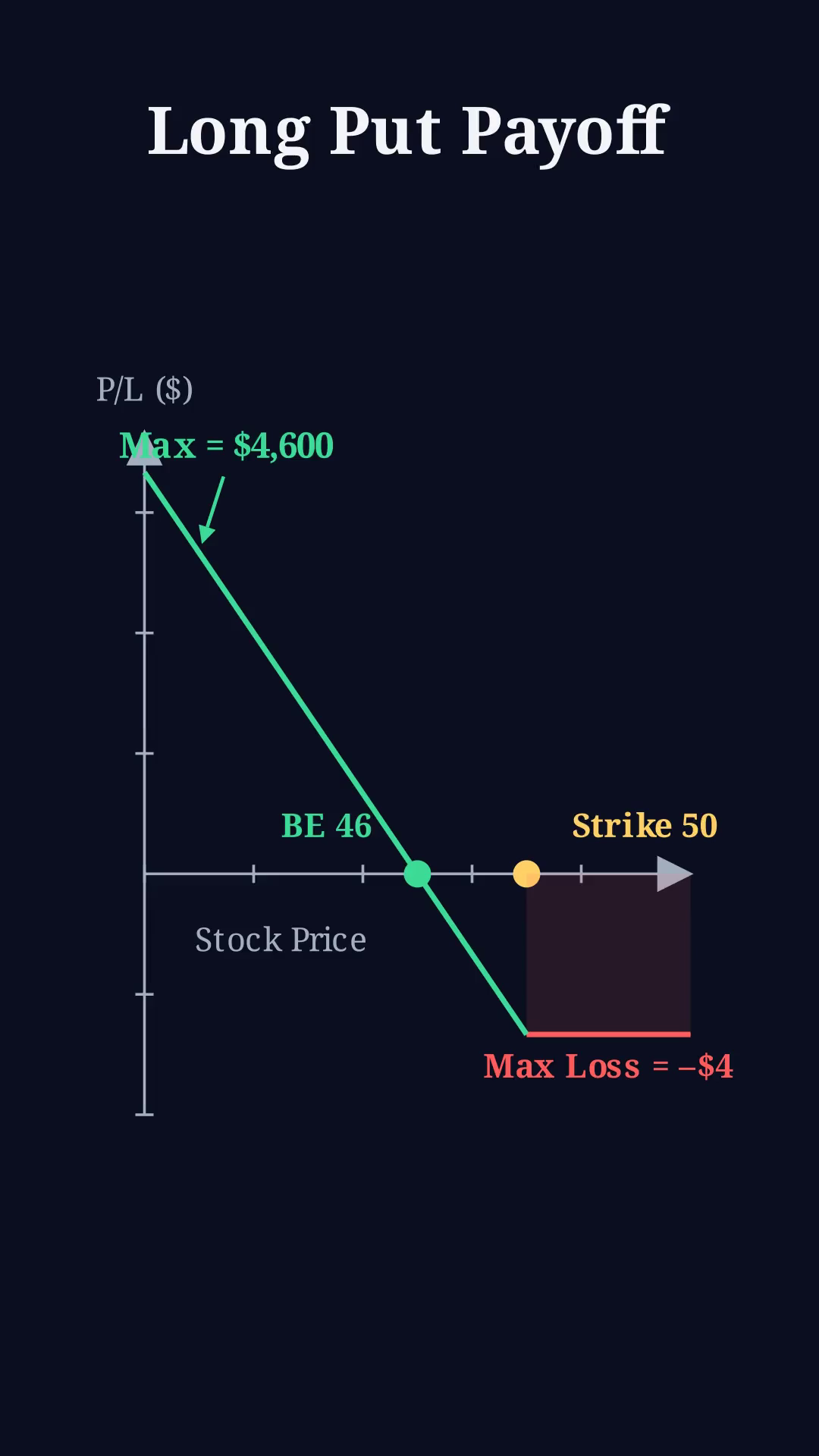
Three things to read off this chart instantly on test day:
- Flat line at −4 for any stock price ≥ 50 (the strike). You lose the premium and nothing more.
- Diagonal line crossing zero at 46. That's your breakeven: strike − premium.
- Capped gain on the left at $4,600 (when stock hits $0). The line stops climbing — there is a ceiling.
If you can sketch this diagram from memory in 15 seconds, you'll get every long-put question right.
Why This Question Trips People Up
The Series 7 writers know exactly which traps work on long puts:
Trap 1: "Unlimited" by analogy. Candidates who learned long calls first remember "max gain = unlimited" and apply the same logic to puts. This is wrong. Long calls have unlimited upside because stocks can theoretically rise forever. Long puts are capped because stocks can only fall to $0. The bound is asymmetric.
Trap 2: Forgetting to multiply by 100. Each option contract represents 100 shares. The formula is (Strike − Premium) × 100, not just Strike − Premium. If you write "$46" as your max gain, you got it almost right — and got zero credit.
Trap 3: Anchoring on the current stock price. When the question says "stock drops to 38," your brain wants to compute ($46 − $38) × 100 = $800 as the answer. That's the current profit. Max gain asks for the theoretical maximum, which assumes the stock falls all the way to zero.
The fix: when you see "long put" + "max gain," your hand should write (Strike − Premium) × 100 before you finish reading the question.
How Long Puts Compare to Other Positions
The Series 7 will test you on all four basic positions in the same testlet. Here's the full comparison so you don't mix them up:
| Position | Max Loss | Max Gain | Breakeven |
|---|---|---|---|
| Long call | Premium | Unlimited | Strike + Premium |
| Short call | Unlimited | Premium | Strike + Premium |
| Long put | Premium | (Strike − Premium) × 100 | Strike − Premium |
| Short put | (Strike − Premium) × 100 | Premium | Strike − Premium |
Notice the symmetry: long positions cap your loss at the premium. Short positions cap your gain at the premium. The asymmetry between calls and puts comes from the fact that stocks can rise forever but can't fall below zero.
Common Series 7 Question Variants
Expect these phrasings on the actual exam:
- "What is the maximum potential gain?" → (Strike − Premium) × 100 (for any long put).
- "At what price does the investor break even?" → Strike − Premium.
- "What is the maximum loss?" → Premium paid × 100 (or just "the premium").
- "At expiration, what is the investor's profit/loss if the stock is at $X?" → If X ≥ strike, loss = premium. If X < strike, profit = (strike − X − premium) × 100.
- "Will the investor exercise?" → Yes if stock < strike (any amount), even if still above breakeven. Exercising recoups some of the premium; letting it expire recoups nothing.
That last one is sneaky — exercising at $49 on a $50 strike with $4 premium still loses you $3/share, but it loses less than letting the option expire and eating the full $4 premium.
The Mental Model That Sticks
Think of a long put as insurance on a stock you don't own:
- You pay a fixed price (the premium) for the right to sell at a fixed price (the strike).
- If the stock crashes, you collect — but only down to zero, because that's as low as it goes.
- If the stock holds or rises, you walk away — your "loss" is just the premium.
- The maximum payout is bounded by the strike itself, since the stock can't be worth less than nothing.
That bounded asymmetry — small fixed downside, large but capped upside — is what makes long puts different from long calls. The exam wants to make sure you understand that the bound exists and where it sits.
Practice Question
<details> <summary>Click for answer</summary>A customer buys 1 ABC October 75 put at 3. At expiration, ABC is trading at $76. What is the customer's profit or loss?
Loss of $300.
ABC ($76) is above the strike ($75), so the put expires worthless. The customer loses the entire premium: $3 × 100 = $300.
Note: even though ABC is only $1 above the strike, the customer doesn't exercise — exercising would mean selling at $75 when the market price is $76, which would lock in a $1 loss per share plus the premium. Letting it expire just costs the premium.
</details>What's Next
This is two of ~40 options concepts tested on the Series 7. The most commonly missed (in order) are:
- Long call payoffs ← lesson #1
- Long put payoffs ← you're here
- Covered call writing (coming soon)
- Protective puts (coming soon)
- Straddles vs. spreads (coming soon)
If this guide helped, the 60-second video version is here — same content, designed to lock the diagram into your memory before sleep.
Series7Labs builds short-form explainers and study guides for every question type on the FINRA Series 7. Free forever. No login. No upsells until you're ready for the full course.
Related: All Series 7 lessons · Why options dominate the Series 7 · About Series7Labs