Long Call Payoff Diagram — Series 7 Cheat Sheet & Full Walkthrough
Updated April 2026 · 6 min read · Part of the Series 7 Options Crash Course
If you only have 60 seconds before your test, read the cheat sheet. If you want to actually understand long calls so you stop second-guessing yourself in the testlet, scroll past it.
The 60-Second Cheat Sheet
For any long call position on the Series 7:
| Metric | Formula | Memory hook |
|---|---|---|
| Maximum loss | Premium paid | "You can only lose what you put in" |
| Maximum gain | Unlimited | Stock can theoretically rise forever |
| Breakeven | Strike + Premium | "Pay to play, then climb above strike" |
| Profitable when | Stock price > Strike + Premium | Above breakeven |
| At expiration | Exercise if stock > strike, else let expire | OTM calls expire worthless |
The trap question pattern: The exam will give you a stock price above the strike and ask for max gain. Candidates anchor on the number in the question and pick a finite answer. Max gain on any long call is always unlimited — full stop. The current stock price is irrelevant to that answer.
Worked Example (the one from the video)
Buy 1 XYZ January 50 call at 3. Stock rises to 58. What's the max gain?
- Strike: 50
- Premium paid: 3 (× 100 shares = $300 total cost)
- Breakeven: 50 + 3 = $53
- Profit at $58: ($58 − $53) × 100 = $500
- Max loss: $300 (the premium, if stock stays at or below $50)
- Max gain: Unlimited — not $500, not $800
The $500 is the current unrealized gain. The maximum possible gain is unbounded because XYZ could go to $100, $500, $5,000.
The Payoff Diagram
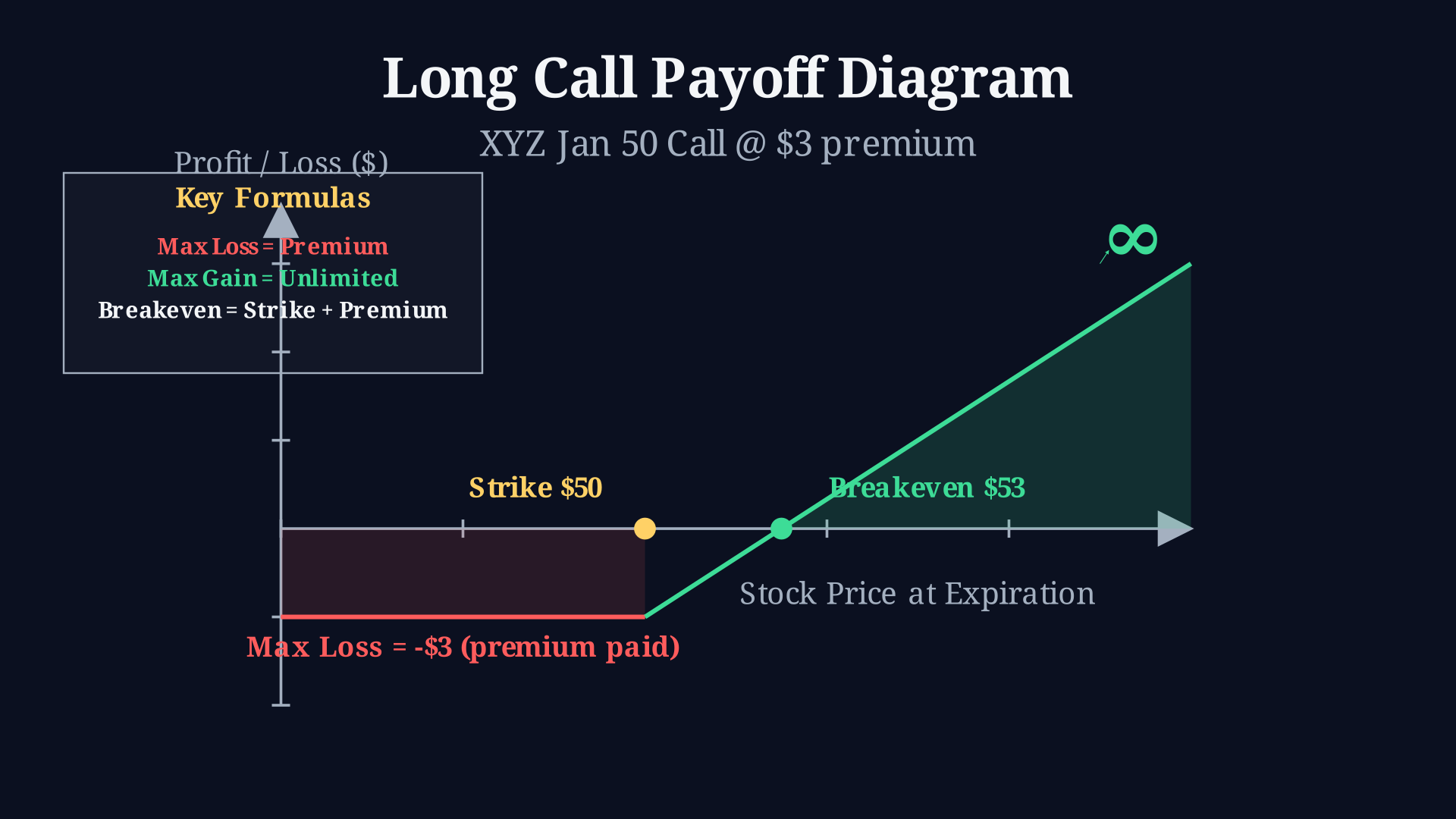
Three things to read off this chart instantly on test day:
- Flat line at −3 for any stock price ≤ 50 (the strike). You lose the premium and nothing more.
- Diagonal line crossing zero at 53. That's your breakeven: strike + premium.
- Arrow pointing up and to the right. That arrow is the entire reason long calls exist — there's no ceiling.
If you can sketch this diagram from memory in 15 seconds, you'll get every long-call question right.
Why This Question Trips People Up
The Series 7 writers know two specific traps work:
Trap 1: Conflating premium with max gain. The premium ($3, or $300) is the cost. Beginners see "$300" in the question and want to use it as the answer. It's the max loss, never the max gain.
Trap 2: Anchoring on the stock price given. When the question says "stock rises to 58," your brain wants to compute a number. But "max gain" asks about the theoretical maximum, not the current state. The only correct answer for any long call's maximum gain is unlimited.
The fix: when you see "long call" + "max gain," your hand should write "unlimited" before you finish reading the question.
How Long Calls Compare to Other Positions
The Series 7 will test you on all four basic positions in the same testlet. Here's the full comparison so you don't mix them up:
| Position | Max Loss | Max Gain | Breakeven |
|---|---|---|---|
| Long call | Premium | Unlimited | Strike + Premium |
| Short call | Unlimited | Premium | Strike + Premium |
| Long put | Premium | Strike − Premium (× 100) | Strike − Premium |
| Short put | Strike − Premium (× 100) | Premium | Strike − Premium |
Notice the symmetry: long positions cap your loss at the premium. Short positions cap your gain at the premium. Memorize the long call, then flip it for the others.
Common Series 7 Question Variants
Expect these phrasings on the actual exam:
- "What is the maximum potential gain?" → Unlimited (for any long call).
- "At what price does the investor break even?" → Strike + Premium.
- "What is the maximum loss?" → Premium paid × 100 (or just "the premium").
- "At expiration, what is the investor's profit/loss if the stock is at $X?" → If X ≤ strike, loss = premium. If X > strike, profit = (X − strike − premium) × 100.
- "Will the investor exercise?" → Yes if stock > strike (any amount), even if still below breakeven. Exercising recoups some of the premium; letting it expire recoups nothing.
That last one is sneaky — exercising at $51 on a $50 strike with $3 premium still loses you $2/share, but it loses less than letting the option expire and eating the full $3 premium.
The Mental Model That Sticks
Think of a long call as a lottery ticket with a refund window:
- You pay a fixed price (the premium) for the right to buy at a fixed price (the strike).
- If the stock takes off, you keep collecting upside forever.
- If the stock flops, you walk away — your "loss" is just the ticket price.
- The "refund window" is exercising before expiration if the stock is above the strike, even if you're still under breakeven.
That asymmetry — small fixed downside, uncapped upside — is exactly why long calls are tested heavily on the Series 7. The exam wants to make sure you understand that asymmetry well enough to advise a real client.
Practice Question
<details> <summary>Click for answer</summary>A customer buys 1 ABC October 75 call at 2. At expiration, ABC is trading at $74. What is the customer's profit or loss?
Loss of $200.
ABC ($74) is below the strike ($75), so the call expires worthless. The customer loses the entire premium: $2 × 100 = $200.
Note: even though ABC is only $1 below the strike, the customer doesn't exercise — exercising would mean buying at $75 to immediately sell at $74, plus eating the premium. Letting it expire just costs the premium.
</details>What's Next
This is one of ~40 options concepts tested on the Series 7. The most commonly missed (in order) are:
- Long call payoffs ← you're here
- Long put payoffs (coming soon)
- Covered call writing (coming soon)
- Protective puts (coming soon)
- Straddles vs. spreads (coming soon)
If this guide helped, the 60-second video version is here — same content, designed to lock the diagram into your memory before sleep.
Series7Labs builds short-form explainers and study guides for every question type on the FINRA Series 7. Free forever. No login. No upsells until you're ready for the full course.
Related: All Series 7 lessons · Why options dominate the Series 7 · About Series7Labs